Wednesday, October 2, 2013

Minimum Wage Criticisms are Outdated

The minimum wage debate has recently been in the news as Governor Brown signed into law a minimum wage increase in California and as - what seems like eons ago - President Obama proposed a minimum wage hike in the State of the Union address. Of course, the usual voices on the right have come out against increasing the minimum wage (or even having a minimum wage altogether). Kevin Hassett of the American Enterprise Institute, a conservative think tank, argued against the minimum wage here in what looks like a rewrite of his 2006 piece against increasing the minimum wage. The Heritage Foundation, another conservative think tank, had blog posts against increasing the minimum wage herehere, and here. There are many more posts and studies from the Heritage Foundation against the minimum wage if you're interested (apparently, they really hate the minimum wage). We also have University of Chicago economist John Cochrane here and Harvard economist Greg Mankiw here.

So what gives? Why are conservatives against the minimum wage? Anybody who has taken an Econ 101 class knows what the argument is: that a raise in the minimum wage is a raise in the cost of labor - and when costs rise, demand falls. The true minimum wage should not be determined by government fiat, but by labor's marginal productivity. If the government raises the cost of labor above labor's marginal productivity, then the result will be greater unemployment. This is the argument of classical economics. And it's available as a fun graph:


Now, as fun as this graph is, this fun does not compensate for the fact that this argument is outdated. Classical economics came of age during the middle of the Industrial Revolution. During the Industrial Revolution, many low-wage toilers toiled their days away in factories or mines producing products. When you are producing product it makes sense to talk about productivity as a determinant of labor's value (to be fair, the term productivity has taken on a more abstract meaning in economics beyond the production of goods, but the crux of the argument remains). If you owned a factory, you could produce more goods by hiring more and more workers and cramming them into your factory until the added productivity of an additional worker equaled the cost of that worker (the worker's wage). Now, this is of course assuming that somebody is willing and able to buy all the crap that you're producing (who needs a minimum wage law when you have Say's law!).

But low-wage workers in America don't really work in factories or mines anymore. They overwhelmingly work in service-sector industries such as retail or food service. In these industries, adding more workers to your store does not add to your overall production - it just adds to the number of people standing there looking at each other when there are no customers. If you own a store, you're only going to hire as many workers as it takes to man the shop, and this number is determined largely by customer demand - not by a capital-intensive conception of the marginal productivity of labor. This is why we are currently seeing stories about Amazon and Walmart hiring a ton of seasonal workers in order to prepare for the increased demand that comes with the holiday season. In this kind of economy, the demand for labor in the fun graph wouldn't be at a 45 degree angle; it would be nearly vertical. Raising the minimum wage would not increase unemployment, because a good retail company would already be running stores with the minimum amount of workers needed.

Of course, a minimum wage hike won't occur in a vacuum. The increased cost of labor will have to get absorbed somewhere. Jared Bernstein has a good piece that examines some studies that aim to find out just where the increased wages are absorbed. The two most plausible avenues are lower profit margins for employers and increased prices. Prices won't rise too much, though, as labor costs account for only a portion of a firm's overall costs. So if you're looking for a way to steer record-high corporate profits into the pockets of workers, a minimum wage hike is the way to go.

Just to be clear: I am not advocating a minimum wage of $100 an hour (conservatives sure do enjoy their slippery slope arguments). It is possible to raise the minimum wage to a point where running a retail establishment or fast food restaurant would be unprofitable, leading many firms to exit these sectors. However, I highly doubt that the line from profitability to unprofitably will be crossed because of an extra $1.75 per hour.

Also, here's David Cross talking about the minimum wage:


Tuesday, October 1, 2013

Sticky Wages are Good Wages

Justin Wolfers has a good piece in Bloomberg reminding us that the Fed is going to be undershooting its inflation target (by its own estimation) for at least three more years. But don't worry about deflation just yet. Looking at the Federal Reserve's projections, the bottom of the range of their projections for inflation is 1% - and this was revised up from June's lowest projection 0.8%, suggesting that inflationary pressures are (barely) increasing instead of decreasing.  But, moreover, our lived economic experience suggests that wage and price stickiness is a real thing. Paul Krugman deals with this a bit here. In his post, he notes a Brookings paper titled "the Macroeconomics of Low Inflation." I think that this paper deserves a more in-depth look.

In this paper, the authors do several things. First, they argue that the reluctance of firms to cut nominal wages and the reluctance of workers to accept cuts to nominal wages is a real phenomenon and has been empirically observed. By reviewing various BLS data, Akerlof and co. found that during the 60's, 70's, and 80's, wage cuts were very rare. Even during the severe recession of 1981-82, wage freezes were much more common than wage cuts.

Second, they argue that previous studies that show that wages don't show downward nominal rigidity (that wages can be cut and often are) were prone to reporting error - survey respondents would report wage cuts that didn't actually happen.

Third, they create two models - one that incorporates wages that aren't cut easily (sticky wages) and one that incorporates wages that can be cut easily (flexible wages) - and run them following the shocks of the Great Depression. While the model with flexible wages predicted massive deflation that never actually happened, the model with sticky wages tracked the actual inflation path of the US economy fairly well.

So what are the real world policy implications of wages that just refuse to be cut? The biggest implication is that we live in a world where the employment market can only adjust wages upward. If the employment market needs to adjust wages downward, then it's going to have no choice but to hold nominal wages steady and wait for inflation to bring real wages down to where they need to be. This could take quite some time if you're only getting inflation at 1% as we are now. A corollary to this is that an economy with complete price stability (zero inflation) will have no mechanism to adjust wages downward leading to a much more inefficient economy with a significantly higher level of unemployment.

If nominal wage rigidity causes such problems, can't we just get rid of it? This seems to be the radical conservative economic plan. By getting rid of unions, minimum wage laws, and other statutory reinforcements of nominal wage rigidity, wages will finally be free to adjust downwards and we can live in a utopia of stable prices and fully flexible wages. However, as much trouble as sticky wages cause, they save us from a much bigger problem: mass debt defaults. Your wages may be cut, but your mortgage payments stay the same. By preventing mass debt defaults, sticky wages serve as an important safeguard against greater damage to the financial system during times of high economic stress.


Wednesday, September 25, 2013

This is What Bending the Cost Curve Looks Like

There are many scare stories coming out about how the Affordable Care Act is forcing health care providers to cut budgets (notably, the Cleveland Clinic). The Atlantic did an admirable job in setting the record straight about these budget cuts by (shock) actually talking to the Cleveland Clinic. A notable quote from the article:
Actually, much of what the Cleveland Clinic system is doing follows the recommendations of health-care analysts closely. For example, it has consolidated closely located neonatal intensive care units, because high volumes tend to lead to better results. It's working to reduce the number of procedures its staff performs, since in the current system "physicians are rewarded to do more, not to do the right thing for the patient," as Sheil put it. And there's a new focus on chronic diseases, which are an increasingly important and costly area for treatment.
Note: all of these changes mean less revenue for the Cleveland Clinic. Or, in other words, less money is being spent in health care than otherwise would have been. This is what bending the cost curve looks like.

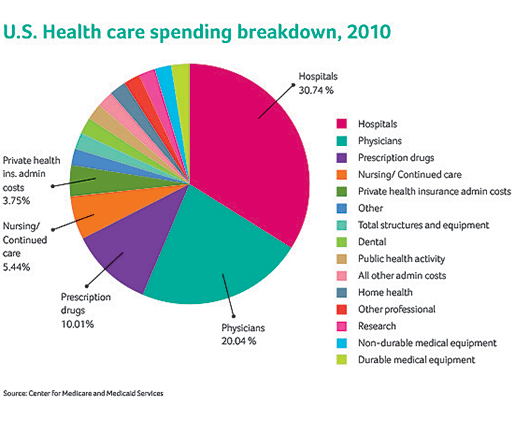
When we talk about bending the cost curve in health care, we usually speak in unoffensive terms: stopping duplicative procedures, cutting administrative spending, and replacing brand name drugs with generic drugs. But the first two terms mean less revenue for health care providers (something that the Cleveland Clinic is preparing for in these stories) and the third term just isn't as significant as we'd like it to be. Here's a useful graphic from the CMS:
As you can see, prescription drug spending and private health administration costs (the two most unpopular forms of spending) are just not that significant in the grand scheme of things. What is significant is spending on hospitals and spending on physicians. Thus, if we're actually going to slow health care spending, it is going to be through the means of politically unpopular cuts to hospitals and physicians. This is what bending the cost curve looks like.

Wednesday, September 18, 2013

Deflate Your Enthusiasm

William Pesek argues in an opinion piece in Bloomberg that deflation in Japan is - contrary to popular belief among most economists - actually a good thing. Pesek's reasoning is that Japan's population is disproportionately composed of elderly pensioners living off of fixed income whom would benefit from falling prices. Furthermore, as prices in Japan rose too high during the 1980's, deflation "has acted like a stealth tax cut for households and restored some sobriety to costs." Lastly, the Japanese government has amassed mountains of debt, and deflation - "which lowers nominal bond yields" - "makes that burden easier to service."

This piece is a bit of a ridiculous #slatepitch. Deflation is not good. Deflation is very bad - and most every economist knows this. It is generally agreed upon by both conservative and liberal economists that deflation is one of the main culprits behind the severity of the Great Depression. This is because deflation reduced earnings and increased real debt burdens, leading to mass-scale defaults. We see the same forces at play in Japan (the depressed earnings - not the mass-scale defaults). The following graph shows private sector earnings in blue and the CPI in red. Falling earnings track pretty well with falling prices.


In other words: deflation does not occur in a vacuum - my falling costs are your falling earnings and vice versa.

But how does this affect elderly pensioners? 1) Falling earnings put pressure on private pension systems. If earnings are not sufficient enough to fully fund pensions, then pensions may need to cut their benefits; 2) Falling earnings put pressure on public pension systems. Falling earnings mean depressed tax revenue. If public funds can not sufficiently fund the pension system, then benefits may need to be cut; 3) Falling earnings mean falling stock prices. This reduces the wealth of stock holders (a group that contains a not insignificant number of pensioners). All of these negative effects will be especially felt by near-future and future pensioners.

The worst part of the article, however, is the claim that deflation makes the government's debt easier to service via lower nominal interest rates. Low nominal interest rates (and deflation) are generally a sign of an anemic economy which translates to lower tax revenue. Lower tax revenue means that the government will have a tougher time paying off debt. Furthermore, deflation not only does not ease the burden of debt, it actively increases the burden of debt by increasing the debt's real value.

But let's assume I'm wrong about all of this (which I'm not) and deflation really is a boon to elderly pensioners. Do you really want to use the well-being of pensioners (25% of the population now, projected 40% in 2060) as your benchmark of success for a national economy?

Monday, July 15, 2013

Patently Interesting

Economist Joseph Stiglitz has an interesting op-ed piece in the New York Times about intellectual property and its role in enforcing and increasing economic inequality. He specifically talks about the recent Supreme Court case of Association for Molecular Pathology v. Myriad Genetics in which Myriad Genetics had patented two human genes. In his op-ed piece, Professor Stiglitz writes about the real-world implications of this specific instance. However, while this op-ed piece is definitely worth a read, the more interesting part is the link to his expert declaration with the court in which he outlines the economic theory against the argument that it is only strong intellectual property rights that create incentives for research and development and that without them, R&D simply would not exist on the same level that it does today.

The economic case against strong intellectual property rights rests mainly on the "chain-reaction" nature of technological advancement. That 1) a current invention is building upon existing technology; and 2) future inventions will follow from the current invention.

With regards to part 1, Professor Stiglitz states: "The 'marginal social return' is having innovation available earlier than it otherwise would have been. In other words, if the invention was to have occurred anyway, then the contribution of the 'inventor' is that it occurred earlier than it would have without the incentives offered by the patent system." This takes a largely deterministic view of scientific advancement (something that is in line with our understanding of the simultaneous discoveries of the theory of evolution and calculus) with the implication that the "inventor" is receiving rewards that far exceed his or her contribution to society.

With regards to part 2, Professor Stiglitz states: "There are many instances where the intellectual property regime has impeded innovation, or would have done so had the government not intervened (as it did in the case of airplanes) or the Courts had ruled differently (as in the case of the development of the automobile)." Put in a different way, while the US patent system may encourage a quicker development of a particular invention, subsequent inventions that follow from that particular invention will be delayed for 20 years (the current length of a patent).

One other social loss that the current IP system engenders is the loss of competition. Firms may be encouraged to compete to be the first to develop a new technology, but once the new technology is patented, monopoly rights will be given and further developments in this technology will languish until the patent expires.

Sure, this is all well and good, and we now have a better understanding of the costs imposed by the patent system, but none of this addresses the core of the argument for strong patent rights: incentives for R&D! Don't worry, Professor Stiglitz addresses this with several arguments. One argument is a soft liberal argument of the pursuit being reward enough for most involved in the scientific community (and while this argument is good enough for my soft liberal heart, I'm sure many more people are rolling their eyes). The more convincing argument, however, is the licensing system. In the licensing system, inventors do not enjoy monopoly rights to their invention. The technology behind their invention is available for all to see, encouraging further development on top of the licensed invention. However, in order to use this technology, one must pay the inventor a licensing fee. Thus, incentives for R&D are preserved and technological advancement is unimpeded.

Wednesday, May 29, 2013

Professional Centrism Now Adding to Trade Deficit

It appears that the Washington Post could not produce enough fake, pompous indignation against both political parties to satiate the domestic market. So, in order to satisfy demand, we are now importing it from England. The Economist, in its May 25th edition, has perfected the production process. They declare that there are three areas in which President Obama can work with Congressional Republicans: immigration, entitlements, and tax reform. They fail to mention important caveats, though.

With regards to immigration: while significant progress has been made on the Senate side, we still don't know whether or not enough Republicans will flock to the bill to get it to the desired 80-vote threshold. What's even less certain is if the Republican-controlled House will take up a large bill dealing with comprehensive reform, let alone vote for such a bill.

With regards to entitlements: the President has already proposed moving Social Security to a chained CPI as well as raising the Medicare eligibility age to 67. These proposals went nowhere. (Granted, these proposals were tied in to a larger compromise. But the compromise was centrist, so centrists should have loved that.)

With regards to tax reform: Representative Camp and Senator Baucus are working on reforming the tax code. The only missing ingredient? The President's blessing, according to the Economist.

Not to skew the Economist too hard. Prima facie, the argument for bipartisan compromise on these three issues is compelling, and the Economist spells out a particularly good case for why compromise should appeal to both sides on the issue of tax reform. But the fact is, the current incarnation of the Republican party has neither the desire nor the incentive to compromise with the President and Senate Democrats on important issues.Compromise with the Democrats helps the Democrats build their brand as a serious, centrist party, while tarnishing the Republicans' brand of unapologetic conservatism that appeals to the only voters that the Republicans need in their heavily gerrymandered districts in November: their base.

Searching for the GE of My Thoughts on DSGE

Noah Smith has an interesting post on the encouraging further developments of the DSGE model which got me to thinking about my last post: I feel as if I come off strongly in favor of DSGE models. While I have a certain fondness for DSGE models (it was the first macroeconomic model I was able to modify and simulate to my own whims; and it's still influential in economic circles) I am completely aware of their limitations. What I do feel, however, is that Mark Buchanan did not address these limitations and, instead, attacked the model from a more populist viewpoint that adds little to the conversation of economic modeling.