Wednesday, September 25, 2013

This is What Bending the Cost Curve Looks Like

There are many scare stories coming out about how the Affordable Care Act is forcing health care providers to cut budgets (notably, the Cleveland Clinic). The Atlantic did an admirable job in setting the record straight about these budget cuts by (shock) actually talking to the Cleveland Clinic. A notable quote from the article:
Actually, much of what the Cleveland Clinic system is doing follows the recommendations of health-care analysts closely. For example, it has consolidated closely located neonatal intensive care units, because high volumes tend to lead to better results. It's working to reduce the number of procedures its staff performs, since in the current system "physicians are rewarded to do more, not to do the right thing for the patient," as Sheil put it. And there's a new focus on chronic diseases, which are an increasingly important and costly area for treatment.
Note: all of these changes mean less revenue for the Cleveland Clinic. Or, in other words, less money is being spent in health care than otherwise would have been. This is what bending the cost curve looks like.

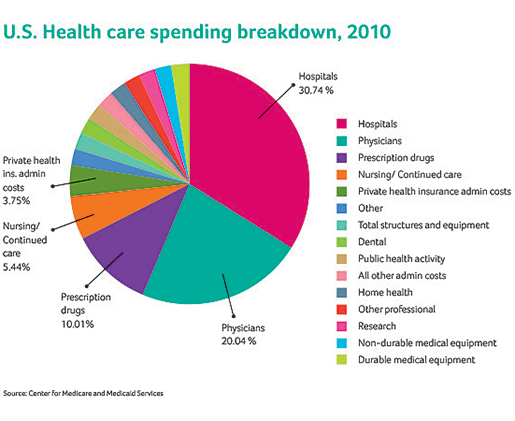
When we talk about bending the cost curve in health care, we usually speak in unoffensive terms: stopping duplicative procedures, cutting administrative spending, and replacing brand name drugs with generic drugs. But the first two terms mean less revenue for health care providers (something that the Cleveland Clinic is preparing for in these stories) and the third term just isn't as significant as we'd like it to be. Here's a useful graphic from the CMS:
As you can see, prescription drug spending and private health administration costs (the two most unpopular forms of spending) are just not that significant in the grand scheme of things. What is significant is spending on hospitals and spending on physicians. Thus, if we're actually going to slow health care spending, it is going to be through the means of politically unpopular cuts to hospitals and physicians. This is what bending the cost curve looks like.

Wednesday, September 18, 2013

Deflate Your Enthusiasm

William Pesek argues in an opinion piece in Bloomberg that deflation in Japan is - contrary to popular belief among most economists - actually a good thing. Pesek's reasoning is that Japan's population is disproportionately composed of elderly pensioners living off of fixed income whom would benefit from falling prices. Furthermore, as prices in Japan rose too high during the 1980's, deflation "has acted like a stealth tax cut for households and restored some sobriety to costs." Lastly, the Japanese government has amassed mountains of debt, and deflation - "which lowers nominal bond yields" - "makes that burden easier to service."

This piece is a bit of a ridiculous #slatepitch. Deflation is not good. Deflation is very bad - and most every economist knows this. It is generally agreed upon by both conservative and liberal economists that deflation is one of the main culprits behind the severity of the Great Depression. This is because deflation reduced earnings and increased real debt burdens, leading to mass-scale defaults. We see the same forces at play in Japan (the depressed earnings - not the mass-scale defaults). The following graph shows private sector earnings in blue and the CPI in red. Falling earnings track pretty well with falling prices.


In other words: deflation does not occur in a vacuum - my falling costs are your falling earnings and vice versa.

But how does this affect elderly pensioners? 1) Falling earnings put pressure on private pension systems. If earnings are not sufficient enough to fully fund pensions, then pensions may need to cut their benefits; 2) Falling earnings put pressure on public pension systems. Falling earnings mean depressed tax revenue. If public funds can not sufficiently fund the pension system, then benefits may need to be cut; 3) Falling earnings mean falling stock prices. This reduces the wealth of stock holders (a group that contains a not insignificant number of pensioners). All of these negative effects will be especially felt by near-future and future pensioners.

The worst part of the article, however, is the claim that deflation makes the government's debt easier to service via lower nominal interest rates. Low nominal interest rates (and deflation) are generally a sign of an anemic economy which translates to lower tax revenue. Lower tax revenue means that the government will have a tougher time paying off debt. Furthermore, deflation not only does not ease the burden of debt, it actively increases the burden of debt by increasing the debt's real value.

But let's assume I'm wrong about all of this (which I'm not) and deflation really is a boon to elderly pensioners. Do you really want to use the well-being of pensioners (25% of the population now, projected 40% in 2060) as your benchmark of success for a national economy?

Monday, July 15, 2013

Patently Interesting

Economist Joseph Stiglitz has an interesting op-ed piece in the New York Times about intellectual property and its role in enforcing and increasing economic inequality. He specifically talks about the recent Supreme Court case of Association for Molecular Pathology v. Myriad Genetics in which Myriad Genetics had patented two human genes. In his op-ed piece, Professor Stiglitz writes about the real-world implications of this specific instance. However, while this op-ed piece is definitely worth a read, the more interesting part is the link to his expert declaration with the court in which he outlines the economic theory against the argument that it is only strong intellectual property rights that create incentives for research and development and that without them, R&D simply would not exist on the same level that it does today.

The economic case against strong intellectual property rights rests mainly on the "chain-reaction" nature of technological advancement. That 1) a current invention is building upon existing technology; and 2) future inventions will follow from the current invention.

With regards to part 1, Professor Stiglitz states: "The 'marginal social return' is having innovation available earlier than it otherwise would have been. In other words, if the invention was to have occurred anyway, then the contribution of the 'inventor' is that it occurred earlier than it would have without the incentives offered by the patent system." This takes a largely deterministic view of scientific advancement (something that is in line with our understanding of the simultaneous discoveries of the theory of evolution and calculus) with the implication that the "inventor" is receiving rewards that far exceed his or her contribution to society.

With regards to part 2, Professor Stiglitz states: "There are many instances where the intellectual property regime has impeded innovation, or would have done so had the government not intervened (as it did in the case of airplanes) or the Courts had ruled differently (as in the case of the development of the automobile)." Put in a different way, while the US patent system may encourage a quicker development of a particular invention, subsequent inventions that follow from that particular invention will be delayed for 20 years (the current length of a patent).

One other social loss that the current IP system engenders is the loss of competition. Firms may be encouraged to compete to be the first to develop a new technology, but once the new technology is patented, monopoly rights will be given and further developments in this technology will languish until the patent expires.

Sure, this is all well and good, and we now have a better understanding of the costs imposed by the patent system, but none of this addresses the core of the argument for strong patent rights: incentives for R&D! Don't worry, Professor Stiglitz addresses this with several arguments. One argument is a soft liberal argument of the pursuit being reward enough for most involved in the scientific community (and while this argument is good enough for my soft liberal heart, I'm sure many more people are rolling their eyes). The more convincing argument, however, is the licensing system. In the licensing system, inventors do not enjoy monopoly rights to their invention. The technology behind their invention is available for all to see, encouraging further development on top of the licensed invention. However, in order to use this technology, one must pay the inventor a licensing fee. Thus, incentives for R&D are preserved and technological advancement is unimpeded.
Wednesday, May 29, 2013

Professional Centrism Now Adding to Trade Deficit

It appears that the Washington Post could not produce enough fake, pompous indignation against both political parties to satiate the domestic market. So, in order to satisfy demand, we are now importing it from England. The Economist, in its May 25th edition, has perfected the production process. They declare that there are three areas in which President Obama can work with Congressional Republicans: immigration, entitlements, and tax reform. They fail to mention important caveats, though.

With regards to immigration: while significant progress has been made on the Senate side, we still don't know whether or not enough Republicans will flock to the bill to get it to the desired 80-vote threshold. What's even less certain is if the Republican-controlled House will take up a large bill dealing with comprehensive reform, let alone vote for such a bill.

With regards to entitlements: the President has already proposed moving Social Security to a chained CPI as well as raising the Medicare eligibility age to 67. These proposals went nowhere. (Granted, these proposals were tied in to a larger compromise. But the compromise was centrist, so centrists should have loved that.)

With regards to tax reform: Representative Camp and Senator Baucus are working on reforming the tax code. The only missing ingredient? The President's blessing, according to the Economist.

Not to skew the Economist too hard. Prima facie, the argument for bipartisan compromise on these three issues is compelling, and the Economist spells out a particularly good case for why compromise should appeal to both sides on the issue of tax reform. But the fact is, the current incarnation of the Republican party has neither the desire nor the incentive to compromise with the President and Senate Democrats on important issues.Compromise with the Democrats helps the Democrats build their brand as a serious, centrist party, while tarnishing the Republicans' brand of unapologetic conservatism that appeals to the only voters that the Republicans need in their heavily gerrymandered districts in November: their base.

Searching for the GE of My Thoughts on DSGE

Noah Smith has an interesting post on the encouraging further developments of the DSGE model which got me to thinking about my last post: I feel as if I come off strongly in favor of DSGE models. While I have a certain fondness for DSGE models (it was the first macroeconomic model I was able to modify and simulate to my own whims; and it's still influential in economic circles) I am completely aware of their limitations. What I do feel, however, is that Mark Buchanan did not address these limitations and, instead, attacked the model from a more populist viewpoint that adds little to the conversation of economic modeling.

Wednesday, April 10, 2013

Agent Zero

Mark Buchanan doesn't like the dynamic stochastic general equilibrium (DSGE) model. He doesn't like these macroeconomic models because he believes that a handful of elegant equations can not accurately reflect a "messy reality." And while I share his enthusiasm over the development of agent-based models, and agree that current macroeconomic models have obvious limitations, I disagree with the overall sentiment of his article: that macroeconomic models are inaccurate because they consolidate too many agents into too few equations.

First, representing all households and all firms as one agent each is not as bad as it sounds. If we know that - in aggregate - households spend 70% of their income, there is not too much gained from modeling many different households with varying degrees of consumption, but whose average consumption level is still 70%. It may be interesting to see how different households react to different economic environments, but that's not the overarching goal of macroeconomic models. The overarching goal is to see how the overall economy reacts to different environments.

Second, it's unfair to blame the shortcoming of macroeconomic models in predicting the financial crisis and it's aftermath on the models themselves. Models use historical data. It's very hard to predict a once-in-a-generation economic crisis using a generation's worth of data. For example, look at historical housing prices:

Could your model guess what happened to housing prices after 1/1/2006? I'll give you a hint:


Please, don't hate on DSGE models, hate on DSGE models that use poor assumptions.


Wednesday, April 3, 2013

One Star, Two Parties

Micah Cohen of FiveThirtyEight writes about two of my favorite things: potential Democratic gains and Texas. The question he poses is how much would demographic change help Democrats make gains in Texas? Cohen reaches a pessimistic conclusion: that while Democrats close the gap by 6 points, Texas can still only be downgraded from super-duper Republican to super Republican by 2016. So just how optimistic do we have to be to see a blue Texas?

Well, a very optimistic assumption would be that Democrats could take what they learned in 2008 from every battleground state, and replicate their greatest hits in Texas. This would mean turning out African Americans like they did in Ohio, Latinos like they did in Nevada, and Asian American like they did nationwide. Using the same assumptions as Cohen but applying this new turnout model, Democrats would still only manage to garner 48.5% of the vote. This means that even the greatest hits of 2008 combined with much more favorable demographics still fail to deliver Texas Democrats to the promised land.

Now, one of the questionable aspects of this model is that it assumes that each ethnic group will vote the same way they did in 2016 as they did in 2008. But what if Democrats were able to not only increase turnout, but increase their vote share as well? If we assume that Democrats can win 70% of the Latino vote with a 52% turnout, then Texas finally turns blue as the Democratic nominee wins the state 50.3% to 49.1%.

So, in order for Democrats to win Texas in 2016, they can't just rely on a few big breaks. Every single thing has to go right. But it's not unprecedented for a state's Latino population to go from under 30% turnout to 50% and become much less conservative within one election cycle. Just look at the difference between Nevada in 2004 and Nevada in 2008.

The model for Texas in 2016 won't be Ohio or Virginia. It'll be Nevada.